

Transparent Led Film Screen can control the LED gray level in two ways, one is to change the passing current, and the other is to adjust the pulse width.
1. Change the current passing through the LED transparent screen. Typically, LED tubes allow about 20 amps of continuous operating current. Except for the saturation of red LEDs, the gray scale of other LEDs is basically proportional to the current flowing through them.
2. Using the visual inertia of the human eye, the gray scale control is realized by using the pulse width adjustment method, that is, the light pulse width is changed periodically. As long as the cycle of repeating the power is short enough, the human eye will not feel the jitter of the light-emitting pixels. Because pulse width regulation is more suitable for digital control, when microcomputers are widely used to provide LED display content, basically all LED transparent displays use pulse width to control gray levels.
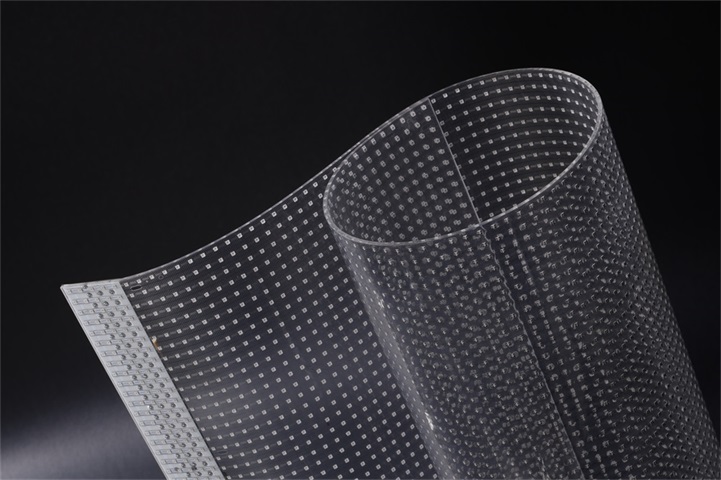
The control system of LED Transparent Film Screen generally consists of the main control box, scanning board and display control device. The main control box obtains the brightness data of each color of the screen pixels from the video card of the computer, and redistributes it to multiple scanning boards. Each scanning board is responsible for controlling several rows and columns on the LED screen. The display control signals of each row of LEDs are transmitted serially.