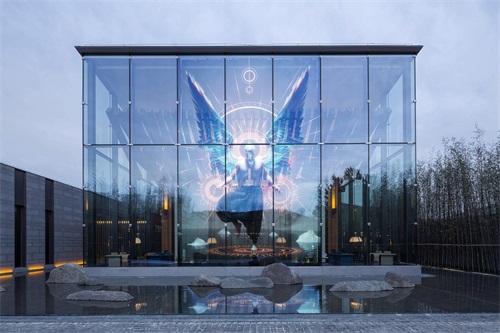
Under normal circumstances, indoor LED flexible transparent screens generate less heat due to low brightness, and can naturally dissipate heat; however, outdoor LED flexible transparent screens generate large heat due to high brightness, and need to be dissipated by air conditioners or axial fans. Since the LED flexible transparent screen is an electronic product, the increase in temperature will affect the light decay of the LED flexible transparent screen lamp beads, the working efficiency of the driver IC, and the service life of the LED flexible transparent screen.
01. LED flexible transparent screen open circuit and failure
The operating temperature of the LED flexible transparent screen exceeds the bearing temperature of the chip, which will rapidly reduce the luminous efficiency of the LED flexible transparent screen, resulting in obvious light decay and damage; the LED flexible transparent screen is mostly encapsulated with transparent epoxy resin. If the junction temperature exceeds At the solid phase transition temperature (usually 125°C), the encapsulation material will change to a rubbery state and the thermal expansion coefficient will rise sharply, resulting in the open circuit and failure of the LED flexible transparent screen.
02. Excessive temperature will affect the light decay of the LED screen
The life of the LED flexible transparent screen is manifested by its light decay, that is, the brightness becomes lower and lower after a long time, until it goes out after Z. Usually, the time when the luminous flux of the LED flexible transparent screen decays by 30 is defined as its life. High temperature is the main source of light decay of LED flexible transparent screen and shortening the life of LED flexible transparent screen. The light decay of different brands of LED flexible transparent screens is different. Usually, LED flexible transparent screen manufacturers will give a set of standard light decay curves. The luminous flux attenuation of the LED flexible transparent screen caused by high temperature is irreversible, and the luminous flux before the irreversible light attenuation of the LED flexible transparent screen is not called the "initial luminous flux" of the LED flexible transparent screen.
03. The increase in temperature will reduce the luminous efficiency of the LED screen
As the temperature increases, the concentration of electrons and holes will increase, the forbidden band width will decrease, and the electron mobility will decrease; as the temperature increases, the radiative recombination probability of electrons and holes in the potential well will decrease, resulting in non-radiative recombination (producing heat), thereby reducing the internal quantum efficiency of the LED flexible transparent screen; the increase in temperature causes the blue light wave peak of the chip to shift to the long-wave direction, which makes the emission wavelength of the chip and the excitation wavelength of the phosphor do not match, which will also cause white light LED flexible transparent screen The external light extraction efficiency decreases; as the temperature rises, the quantum efficiency of the phosphor decreases, the light output decreases, and the external light extraction efficiency of the LED flexible transparent screen decreases; the performance of silica gel is greatly affected by the ambient temperature. As the temperature increases, the thermal stress inside the silica gel increases, resulting in a decrease in the refractive index of the silica gel, thereby affecting the light efficiency of the LED flexible transparent screen.
We also have hot-selling transparent led film, transparent led film display, led transparent film screen, led transparent display, led screen and LED, please click to browse and view, and you can consult us if you are interested.